1Detect
Distributed nodes monitor PM2.5, temperature, and conditions continuously.
Built for places the grid doesn't reach.
Off-grid power, energy storage, and intelligent sensing — designed and built by one engineer, supported directly.
Know about a fire before you can see it.
A network of solar-powered sensor nodes watches your property line around the clock. When the air starts changing — smoke particles rising, temperature climbing — the nodes compare notes with each other and send an early warning to your phone. Not a confirmed fire. An early warning, while there's still time to act.
Distributed nodes monitor PM2.5, temperature, and conditions continuously.
LoRa sends events to the base station on your property. No cellular, no subscription.
The system correlates triggers across multiple nodes and looks for real change, not noise.
You get an early warning on your phone.
Wildfire Detect is a working prototype, not a finished product. Specs will change as field testing teaches us things.
A network of autonomous sensors watches the environment continuously and sends only meaningful changes back to the property gateway.
Each node combines three sensors for redundant fire detection. Rate-of-change triggers, confirmed by base-station consensus across neighboring nodes, reduce false positives.
Chemistry: Li-ion, 3.7 V nominal
Capacity: 3000 mAh single cell, or 6000 mAh (2P)
Runtime (design target): ≈11–12 days single cell, ≈23 days 2P, no sun
Protection: On-board BMS (over/under-voltage, current)
Voltage: 5 V regulated output
Power: 13 W (peak, full sun)
Charge current: Set by the charge controller
Mounting: Adjustable tilt, pole or tree strap
Weatherproof: ETFE laminate, IP67
Cut-off: ~0 °C (charging disabled)
Re-enable: ~2.3 °C (hysteresis)
Implementation: Discrete MOSFET + temp sensor
No MCU required: Fully autonomous
Protects: Cell from lithium plating at low temp
Each node targets approximately 100 m sensing radius in typical forest terrain (field validation pending). A node flags a rise when PM2.5 reaches ≥ 25 µg/m³ and sits ≥ 15 µg/m³ above its own rolling baseline on two consecutive packets. Consensus lives in the base station, not the node: a network Watch requires ≥ 2 neighboring nodes confirmed inside a 20-minute window, and a single elevated node never auto-escalates. Lightning proximity from the AS3935 is an independent input. These thresholds are design targets — field validation is pending. The system reports environmental signatures consistent with an emerging fire — an early warning, not a confirmed fire.
Only environmental telemetry leaves the property: PM2.5, temperature, humidity, pressure, battery voltage. No cameras, no microphones, no GPS coordinates, no device identifiers beyond a random node ID. A local-only mode is available — the base station runs entirely on your LAN with Home Assistant / MQTT, no cloud connection, no away-from-home alerts.
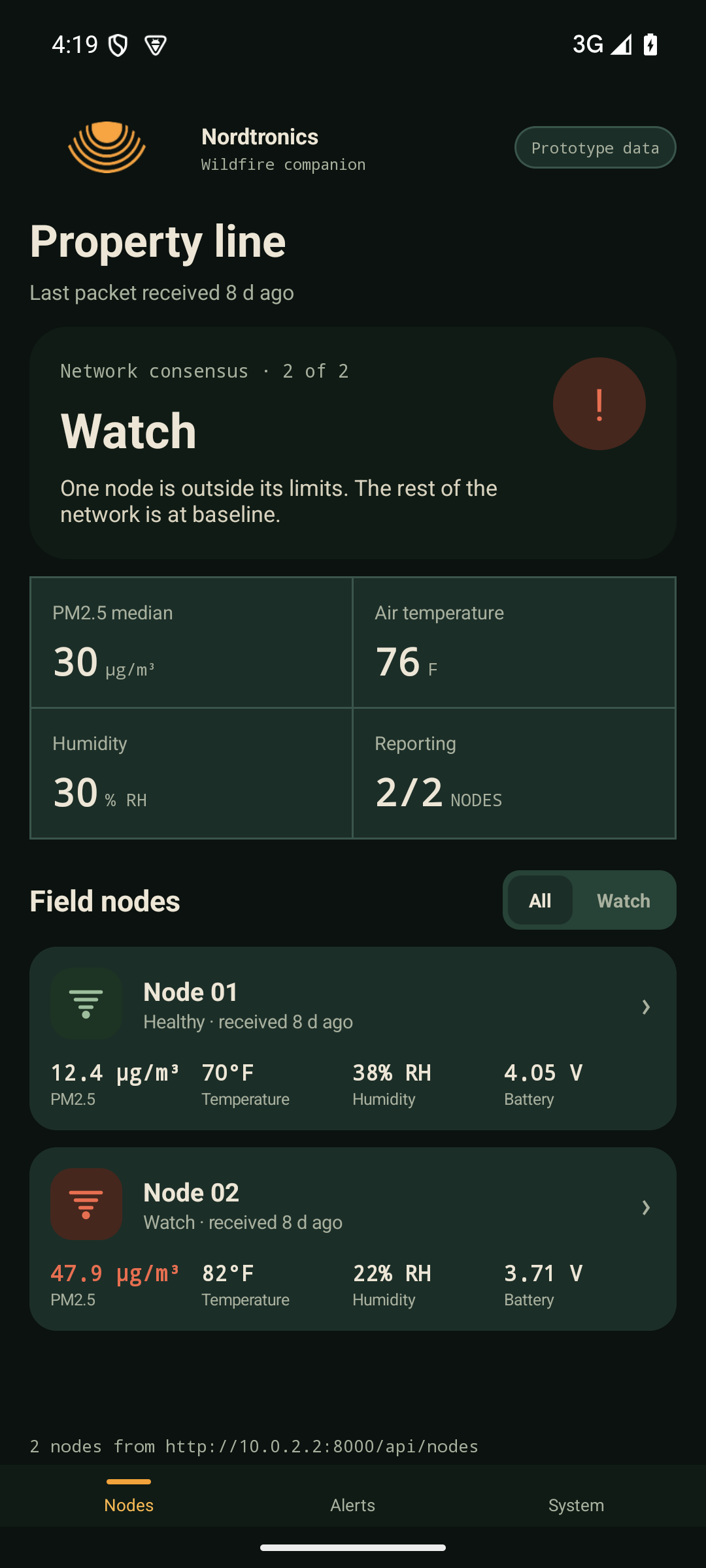
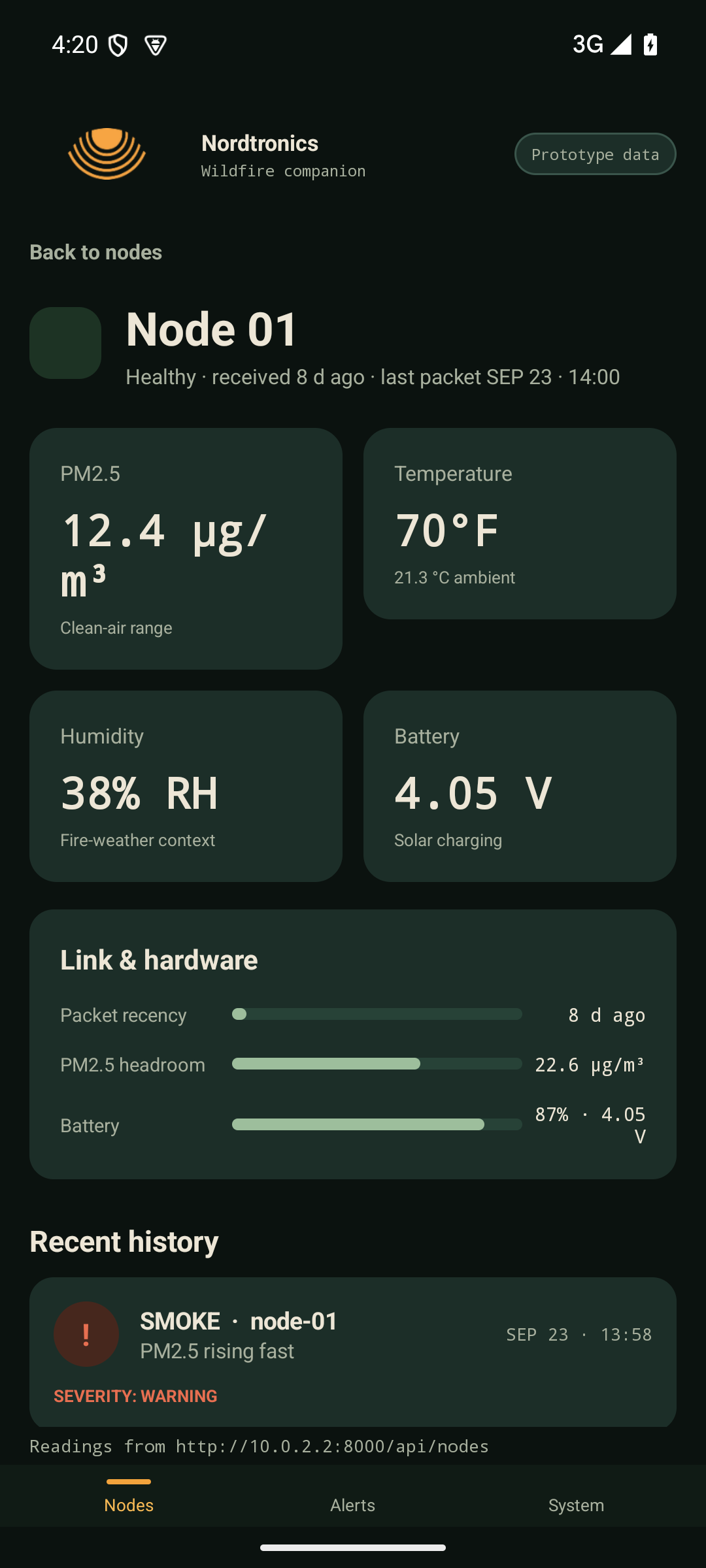
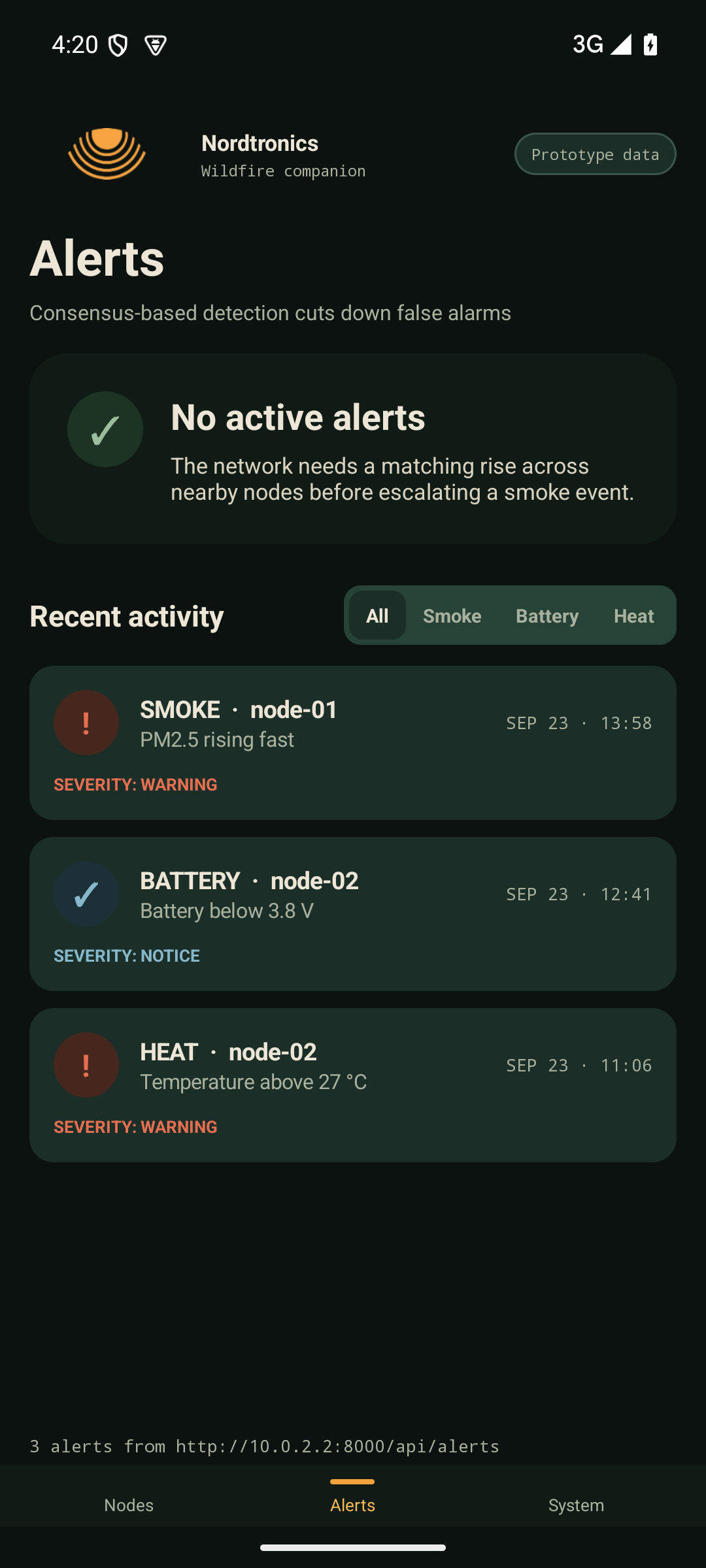
The companion app is a prototype — not on the Play Store. Screenshots from the v0.1 emulator build.
Solar + storage + battery systems for cabins, remote sites, and backup power. Site assessment, design, sourcing, commissioning.
Hardware, firmware, telemetry, automation. If it needs to work where nothing else does, that's the job.
LoRa + ESP32 environmental monitoring. Sensors that run for years on sunshine and report back over miles, not feet.
Built for places the grid doesn't reach. Nordtronics designs power and sensing systems for remote environments — where conventional infrastructure is expensive, unreliable, or just not there. Solar becomes the power plant. Batteries become the grid. LoRa becomes the network. One engineer designs it, builds it, and answers your email when you have questions.
We're looking for pilot partners for the wildfire early-warning network. If you represent an insurance carrier, fire district, community HOA, or landowner group in a high-risk zone, we'd like to talk.
No invented pricing. Pilot scope and cost are scoped per deployment.
Contact Us for Pilot PricingStephen Nordlund founded Nordtronics to build the off-grid power and sensing tools he wanted for his own property in Pagosa Springs, Colorado — a place where the grid ends and the forest begins.
Stephen Nordlund is a systems engineer turned off-grid power and embedded-systems builder. Background: systems engineering, Unix and VMware infrastructure, field service — now solar installs, custom LiFePO4 batteries, and embedded electronics (ESP32, LoRa, Home Assistant) from a shop in Pagosa Springs, Colorado.
Nordtronics is a one-person shop, and that's the point. Direct engineering. Direct support. The person who designs your system is the person who answers your email — six months later, too.
Talk directly to the engineer building the solution. No sales pitch.